
How Long Can You Really Drive on a Spare (or a Flat)? Straight Answers from Ocala
The donut says "temporary use only" and everybody treats it as a suggestion. Here's the honest version: about 50 to 70 miles at 50 mph on a donut, roughly 50 miles on a run-flat, and zero on a flat — plus what each of those actually costs you when you push it.
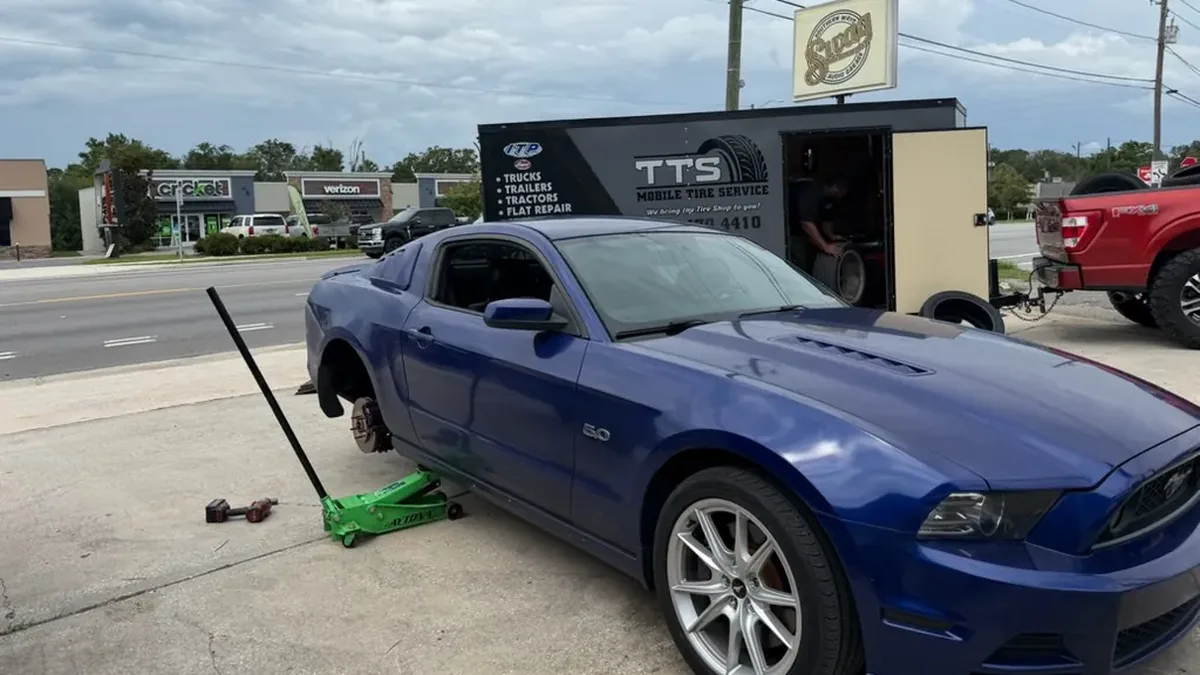
Quick answer: a compact "donut" spare is built for about 50 to 70 miles at no more than 50 mph. A run-flat that's lost its air is good for roughly 50 miles at 50 mph. A regular tire that's flat is good for zero miles — every foot you roll on it is grinding the sidewall apart from the inside. Everything below is the why, and the exceptions.
We get the spare question in two flavors. The first is the driver on the shoulder of I-75 asking whether they can make it home on the donut. The second is the one who's been on the donut for three weeks, Googling "how long can you drive on a spare tire" because a light came on or the car started shimmying on SR-200. Both get the same honest answer, so here it is written down.
The donut: 50 mph, 50–70 miles, and why the number is real
Look at the sidewall of your compact spare. It'll say TEMPORARY USE ONLY and, on most, a max speed of 50 mph. The mileage limit is in your owner's manual — Ford, GM, Honda and Toyota all land in the same place, roughly 50 to 70 miles. That's not lawyers being careful. A donut is a narrower tire with a shallower tread, a lighter belt package, and a smaller overall diameter than the tire it replaced. It grips less, it heats up faster, and it wears out in a few hundred miles instead of a few tens of thousands.
The smaller diameter is the part that quietly costs money. That corner of the car is now spinning faster than the other three. On a front-wheel-drive car with the donut up front, the differential is working the whole time you drive. On an all-wheel-drive vehicle — most Subarus, a lot of trucks and SUVs on the road around Ocala — a mismatched tire can cook the center differential or transfer case. Some AWD manufacturers say to keep donut use under 50 miles for exactly that reason, and a few say don't put it on the drive axle at all. Check the manual before you drive to work on it for a week.
Here's the part nobody mentions: check the donut's pressure before you trust it. Compact spares run around 60 psi, they sit in a trunk for years, and they lose air the whole time. We pull plenty of donuts out of trunks holding 20 psi — which turns a 50-mile spare into a second flat. Same story for age. If the car's ten years old, the spare is ten years old, and a Florida trunk in August is an oven. A cracked, dry-rotted donut is not a spare, it's a decoration.
Not all spares are the same — the honest comparison
"Spare" covers four different things now, and a lot of newer cars don't come with one at all. Here's how far each one really gets you:
| What you've got | Speed limit | Distance | The catch |
|---|---|---|---|
| Compact "donut" spare | 50 mph | About 50–70 mi (see your manual) | Check it's holding ~60 psi first. Mismatched diameter works the differential; AWD vehicles get a shorter leash. |
| Full-size matching spare | Normal | No hard limit | Only if it's the same size, brand and roughly the same tread depth as the other three. Most "full-size" spares are older and on a steel wheel — still check the pressure and get the flat fixed. |
| Run-flat tire (after losing air) | 50 mph | About 50 mi | Once it's been run at zero pressure, most manufacturers say replace, not repair. Ride is harsh and steering feels vague — that's the sidewall carrying the car. |
| Sealant + compressor kit | 50 mph | Manufacturers say roughly 50–100 mi | Only works on small tread punctures. It gums up the inside of the tire and can foul the TPMS sensor. Tell the tech it's in there. |
| A regular tire that's flat | 0 | 0 | Moving to the shoulder is the exception. Anything further destroys the tire and can bend the wheel. |
Speed and distance limits are the manufacturers' published figures — your owner's manual wins if it says something stricter.
Notice the "full-size" row. A full-size spare on a steel wheel with 2007 tread rubber is a lot better than a donut, but if the other three tires are worn down and the spare is brand new, you've still got a diameter mismatch on that corner. On an AWD it matters. On anything else, it's fine to get around on for a while — just don't forget it's back there.
Run-flats: the 50-mile rule, and why "repair" usually isn't on the table
Run-flats get their own section because people search "run flat tires repair" every month hoping for a yes. The honest answer is: sometimes, but usually not after the exact event you're asking about.
A run-flat has a reinforced sidewall that can carry the car with no air in it — typically for about 50 miles at 50 mph (some brands say up to 100, BMW says 50, your manual is the tiebreaker). It's a great feature for getting off I-75 without changing a tire in the dark. The trade-off is what it does to the tire. Fifty miles of carrying a 4,000-pound car on the sidewall stresses the structure in a way you can't inspect from the outside, which is why most manufacturers say a run-flat that's been driven at zero pressure gets replaced. A nail caught early, before you've driven on it flat? Some run-flats can take a proper internal patch — same rules as any tire: tread area only, ¼-inch or smaller, no sidewall. We'll tell you which case you're in. We won't patch one that's been run flat and call it fixed.
One more thing about run-flats: the car usually has no spare at all, and the tire is a specialty size. That's the situation where a mobile tire replacement in Ocala earns its keep — the truck carries the tire to you instead of you paying for a tow to a shop that has to order it anyway.
Driving on an actual flat: what it costs you
A donut is a compromise. A flat is a countdown. When a normal tire loses its air and you keep rolling, the wheel is riding on the two sidewalls folded together, and every rotation chafes the inner liner against itself. Within a mile or two the inside is full of black rubber dust — the tire eating itself. From the outside the sidewall can look fine. When we dismount a tire like that, the damage is obvious in seconds, and it's the reason a tire that was a $75 repair becomes a replacement.
Keep going and the bill grows. The rim starts taking the load, and alloy wheels don't like that — a bent or cracked wheel can cost more than the tire. Keep going further and you'll shred the tire off the rim, and now you're on metal with the ABS and traction control throwing fits. On a wet SR-40 at 55, that's a control problem, not a tire problem.
So the rule is simple: drive on a flat only as far as the nearest safe spot to stop — the next shoulder, the next parking lot, the next exit if you're on the interstate and there's nowhere else. Hazards on, slow, and not a foot further. Then call, because getting the car to a shop is the exact part we take off your hands.
Flat on I-75 or 441? Do this, in this order
We've picked people up on every road in Marion County, and the ones who handle it well all do the same things:
- Get off the traffic side. Hazards on, as far right onto the shoulder as you safely can — behind the guardrail if there is one. Never stand between your car and moving traffic.
- Know where you are. Mile marker, exit number, cross streets, or the business you're sitting outside. "Somewhere on 441" turns a 30-minute response into an hour.
- Check the spare before you fight with it. If it's flat, cracked, or you're on the interstate at night, skip the jack and call. Changing a tire on the I-75 shoulder is a worse gamble than the donut itself.
- If you do mount the donut, stay under 50, get the pressure checked at the first opportunity, and treat the drive home as the whole trip — not the start of a three-week plan.
- If you used a sealant kit, say so when you call. It changes how the repair gets done and whether the sensor survives.
That's also exactly what the 24/7 roadside tire service in Ocala and Marion County is built for. Two in the morning on a Sunday on the shoulder of I-75 is the hour every tire shop in the county has the lights off, and it's the hour we still answer the phone. Repair on the spot if the tire allows it, a replacement off the truck if it doesn't — no tow either way.
What it costs to get off the spare in Ocala
Our pricing is public, so here's the whole number. Every mobile call carries a $100 service fee plus a $20 fuel surcharge — that's the truck, the tire machine and the trip coming to you. If the original tire can be repaired, a passenger flat repair is $75 in our core area ($125 if you're more than about 35 miles out), done properly from the inside, not a string plug. If it can't be repaired, we quote the replacement tire on the phone before we roll and mount it on the spot. Nights, weekends and holidays run at after-hours rates, and you get that number up front too. Either way, whether the tire is a repairable puncture or one that's done is a call we make honestly — we've got no reason to sell you a tire you don't need.
Compare that with what the donut costs when you stretch it: a differential or transfer-case job on an AWD runs into four figures, a blown donut on the interstate is a tow plus a tire anyway, and the repair you were putting off gets more expensive the longer the flat rides around in the trunk. Fifty miles is the spare's job. Getting the real tire back on the car is ours.
On the donut right now — or on the shoulder?
We come to the car with the tire, the machine and the jack. Repair or replacement in your driveway, at work or on the roadside, 24/7 across Marion, Lake and Sumter counties. Quoted on the phone before we roll.
Call (352) 470-4410Quick answers
How long can you drive on a spare tire?
A compact donut spare is built for about 50 to 70 miles at a maximum of 50 mph — the exact number is in your owner’s manual. A full-size matching spare has no hard limit. Either way, treat the spare as the drive home, not a permanent tire, and check its pressure first: donuts run about 60 psi and lose air sitting in the trunk.
How fast can you drive on a donut spare?
50 mph, and the sidewall says so. A donut has less grip, a shallower tread and a smaller diameter than a normal tire, so braking distances get longer and the car handles differently. Stay in the right lane on I-75 and skip the passing.
Can you drive on a flat tire at all?
Only as far as the nearest safe place to stop — the next shoulder, parking lot or exit. Every rotation on a flat chafes the inner liner apart, so a tire that was a $75 repair becomes a replacement within a mile or two, and the wheel can bend or crack after that. Hazards on, slow, then call.
How far can you drive on a run-flat tire with no air?
Most manufacturers say about 50 miles at 50 mph — some allow up to 100, and your owner’s manual is the tiebreaker. After being driven with no pressure, a run-flat generally has to be replaced rather than repaired, because the sidewall that carried the car has been stressed in a way that can’t be inspected.
Can a run-flat tire be repaired?
Sometimes — if the puncture is in the tread area, ¼ inch or smaller, and the tire was not driven on flat. Most manufacturers say a run-flat that has been run at zero pressure gets replaced. We’ll dismount it and tell you which case you’re in rather than patch it and hope.
Do you change a tire on the roadside in Ocala at night?
Yes — we run 24/7, weekends and holidays included, on I-75, US-441, SR-200, SR-40 and across Marion, Lake and Sumter counties. Every call is the $100 service fee plus $20 fuel, then the work ($75 for a passenger flat repair, or the replacement tire quoted on the phone). After-hours rates apply outside weekday business hours, and you get the full number before we roll.
What we do about it
Roadside Tire Service
Stranded on the shoulder is not the moment to start calling around. One number, any hour, and we come to you.
Learn more →Mobile Tire Repair
Picked up a nail on 441? We come to the tire instead of making you drag the tire to us — driveway, work parking lot, or the side of the road.
Learn more →Mobile Tire Replacement
The tire, the install and the disposal in one visit, wherever the vehicle is sitting. You never load a wheel into a trunk.
Learn more →Flat tire? We're already rolling.
Call or text (352) 470-4410 and tell us where you are. Most Ocala-area calls are handled the same day — often within the hour.